A clear, repeatable structure that teachers and children can trust.
Big Maths gives every lesson clarity and purpose through a proven structure. Over 1,200 carefully sequenced small steps, from Early Years to Year 6, so teachers always know exactly what to teach next.

Looking for the Big Maths Beat That! App?
The Big Maths Beat That! App is coming soon, helping children practise the core Learn Its and CLIC facts that build confidence at home.
The CLIC Lesson Structure
Every Big Maths lesson follows the same clear pattern. Children know what to expect, teachers know what to teach, and every element has a purpose.
Counting
Developing number sense and fluency with the number system. Children count in sequences that build and reinforce their understanding of how numbers work.
Learn Its
Building instant recall of 72 core facts: 36 addition facts and 36 multiplication facts. Children learn them steadily, then use fact families to identify related facts.
It’s Nothing New
Every new concept is introduced as an extension of something the child already knows, using child-friendly strategies that reduce anxiety and make learning feel familiar.
Calculation
Applying knowledge to formal calculation methods. Children arrive at calculation with the number sense, facts, and understanding they need.
Why CLIC works: Counting develops the number sense that Learn Its depend on. Learn Its provide instant recall. It’s Nothing New connects that secure knowledge to new learning. Calculation applies everything in context.
Learn Its: 72 facts, taught steadily
Learn Its are the core number facts children need to know instantly. Big Maths keeps the task clear and manageable, so children know what they are learning, why it matters, and how each new fact helps them unlock more maths.
36 addition facts
Children learn the key 1-digit add 1-digit facts that are worth knowing instantly. These facts save children from counting again and again, freeing up attention for the maths they are trying to understand.
36 multiplication facts
Children also learn the key 1-digit times 1-digit facts. These are the facts that later make larger multiplication, division, fractions, decimals, and written methods much easier to manage.
Fact families
Big Maths does not ask children to memorise endless separate subtraction and division facts. Children learn switchers and fact families, so one known fact helps them find the related facts. For example, 6 × 4 = 24 helps unlock 4 × 6 = 24, 24 ÷ 4 = 6, and 24 ÷ 6 = 4.
Steady progress
Learn Its are introduced carefully across the primary years. The aim is not to rush children through facts, but to secure each step properly. Once key facts become automatic, children have more headspace for new methods, problem solving, and confidence.
Why this matters: When children have to work out basic facts every time, their working memory is quickly overloaded. When Learn Its are secure, children can focus on the new learning in front of them. This is one reason Big Maths places Learn Its after Counting and before It’s Nothing New and Calculation.
“It’s Nothing New”: confidence before content
The Big Maths vision is a system where each Progress Drive includes explicitly designed, child-friendly strategies to reduce anxiety and make new learning feel familiar.
We design teaching so that new concepts are introduced as an extension of what pupils already know. If pupils stumble or teachers have to guess, it is not the right Step.
Learning moves through the I do, We do, You do model, supported by Remember To prompts that give children a clear, visible scaffold at every point.
Once a concept has been introduced, children secure it in long-term memory through spaced practice resources. These resources appear where they genuinely serve the learning.
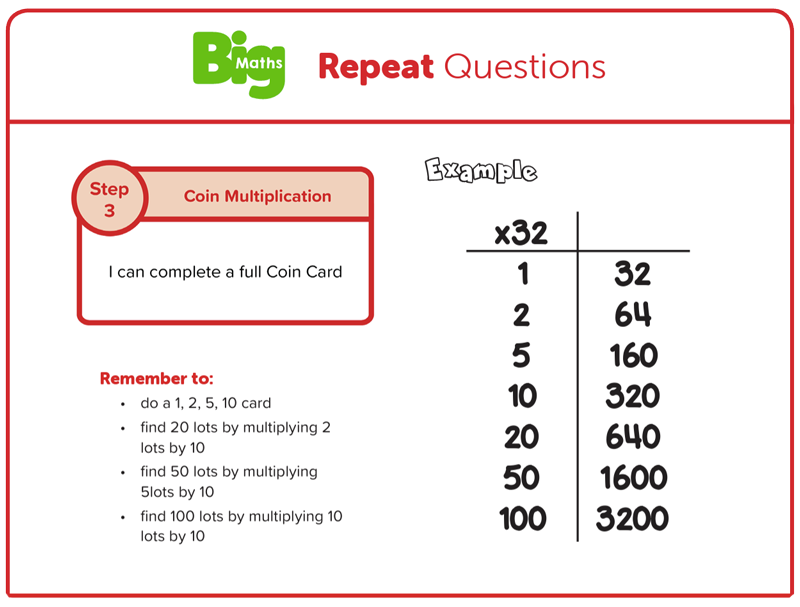
Repeat
Children practise the target skill straight away, building fluency with the strategy they have just been taught.
Revisit
Children meet the skill again after a gap, strengthening recall and helping the learning last.
Real Life Maths
Children apply the skill in context, so the maths connects to situations they can understand.
Select
Children choose between related skills, building judgement rather than just repeating a routine.
I do, We do, You do
Every learning step follows the Gradual Release model, moving children from guided instruction to confident independence.
I do
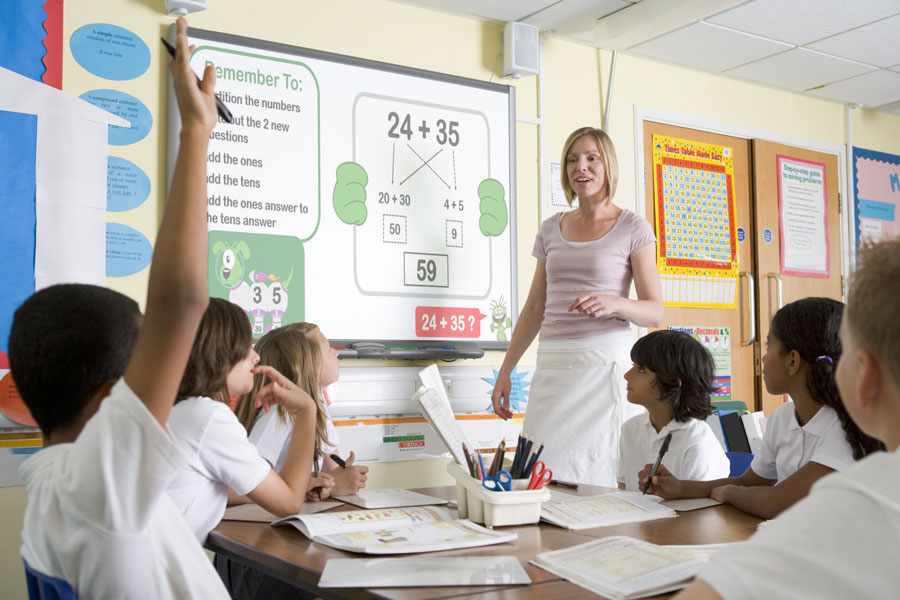
The teacher models the new skill clearly, showing exactly how it is done. The Remember To prompt is visible on screen, giving children a clear reference point.
We do
Teacher and children work through examples together, building confidence step by step. Mini whiteboards help every child stay involved.
You do
Children work independently, applying what they have learned. Because the step is small and the prerequisites are secure, success is designed in.
Progress Drives: over 1,200 small steps from Early Years to Year 6
Big Maths takes broader curriculum statements and breaks them down into smaller, manageable steps. Each strand is a Progress Drive: a carefully sequenced set of learning steps that build towards a larger objective.
Every step includes a Learning Objective and Remember To prompts that serve as success criteria. The number of steps in a Progress Drive varies because each one is deliberately small.
Steps are mapped to age-related expectations term by term, so teachers can see which steps need to be secured each term. Children still work from where they actually are, not where the calendar says they should be.
See Progression & Fluency →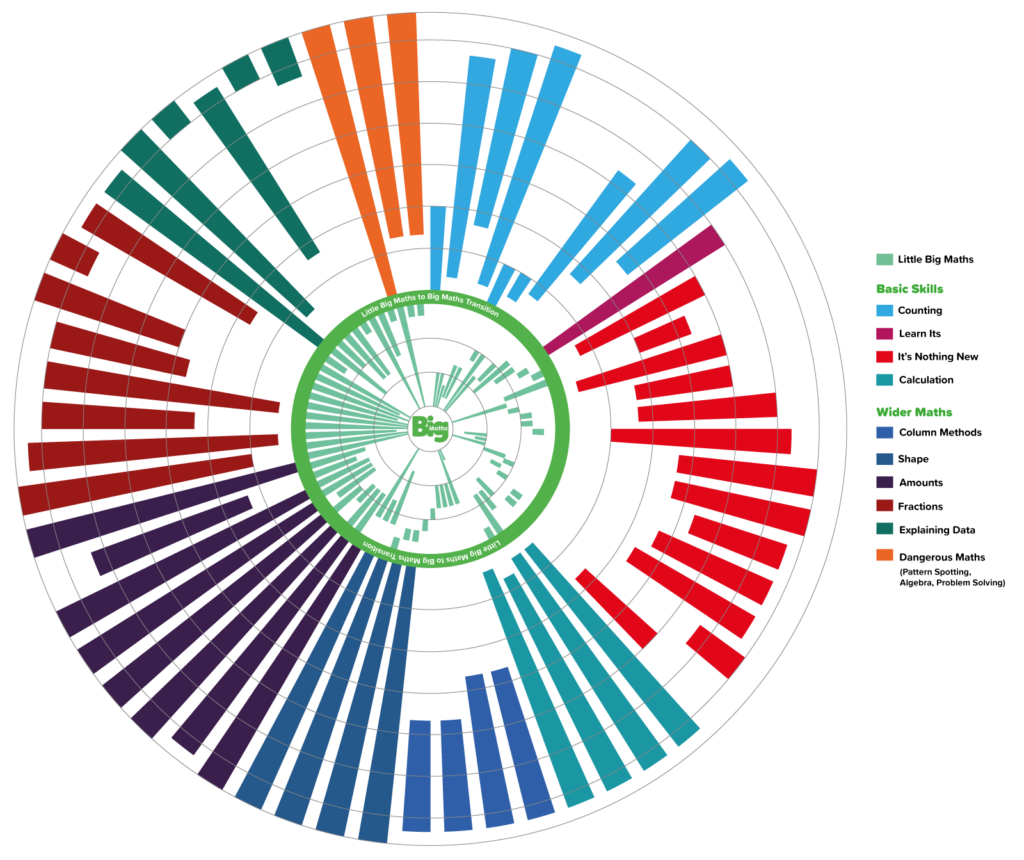
Two frameworks, one coherent system
Big Maths covers the full primary maths curriculum through two interconnected frameworks: Basic Skills (CLIC) for number, and Wider Maths (SAFE) for everything else.
Basic Skills — CLIC
- Counting: Number sense, place value, sequences, and patterns
- Learn Its: Instant recall of the 72 core addition and multiplication facts
- It’s Nothing New: Visual strategies that connect new learning to prior knowledge
- Calculation: Formal written methods, built on secure foundations
- Column Methods: Traditional pencil-and-paper algorithms mapped directly to the core numeracy in CLIC
Wider Maths — SAFE
- Shape: Properties, symmetry, angles, position, and movement
- Amounts: Measurement, money, time, and units of measure
- Fractions: Including decimals, percentages, ratio, and proportion
- Explaining Data: Statistics, charts, tables, and interpretation
- Dangerous Maths: Pure number problems, algebra, number patterns, and investigations
How they connect
- Both frameworks use the same small-step progression model
- Both are mapped to curriculum expectations term by term
- Both are tracked through the same assessment and tracking system
- One subscription covers everything, with no bolt-ons needed

Big Maths Beat That!
Every week, every child takes the Beat That! challenge. The questions on each challenge represent key knowledge for that term, giving the school clear visibility of which pupils are on track.
Beat That! is also the moment children talk about at home. Every child targets their own previous score, and every improvement is celebrated with personalised certificates.
For teachers, the data flows straight into Big Maths Online, identifying Learning Gaps for each child and populating tracking reports. No marking. Minimal workload. Clear next steps.
See Assessment & Tracking →Big Maths has provided us with clear progression across our whole school where each step is broken down into steps that children can actually understand. Since using Big Maths the children in our school are enthused and gaining confidence.
Frequently asked questions
Questions from school leaders, maths leads, teachers, and parents, answered clearly.
What is Big Maths?
Big Maths is a whole-school primary mathematics programme used in over 1,500 schools across England, Scotland, Wales, and international schools. It provides a structured lesson framework (CLIC), over 1,200 small learning steps, weekly assessment through Beat That!, and a complete online resource library.
What does CLIC stand for in Big Maths?
CLIC stands for Counting, Learn Its, It’s Nothing New, and Calculation. Counting develops number sense. Learn Its builds instant recall. It’s Nothing New connects new learning to what children already know. Calculation applies that knowledge to formal methods.
What are Learn Its in Big Maths?
Learn Its are the 72 core number facts children learn to know instantly: 36 addition facts and 36 multiplication facts. Children do not need to memorise endless separate subtraction and division facts. Instead, they learn switchers and fact families so they can use one known fact to identify the related facts.
How is Big Maths different from White Rose Maths?
White Rose Maths organises teaching around age-related curriculum blocks. Big Maths is organised around individual learning steps, over 1,200 of them, from Early Years to Year 6. The key difference is that Big Maths starts from what each child actually knows, not what the calendar says they should know.
Is Big Maths suitable for SEN/ASN pupils?
Yes. Big Maths is particularly well suited to pupils with SEN/ASN because the framework begins below nursery level. Teaching is driven by what each child actually knows rather than their age or year group, so teachers can meet every pupil exactly where they are.
Does Big Maths meet the National Curriculum requirements for England?
Yes. Big Maths covers the full primary maths National Curriculum for England through Basic Skills (CLIC) and Wider Maths (SAFE). All steps are mapped to age-related expectations term by term.
Does Big Maths work in Scotland and Wales?
Yes. Big Maths is used successfully in schools across Scotland, Wales, and England, as well as in international schools following the British curriculum. The framework is mapped to the Curriculum for Excellence in Scotland and curriculum requirements for Wales.
What is Big Maths Beat That!?
Beat That! is the weekly assessment challenge at the heart of Big Maths. Children target their own best ever score, so every improvement is a personal win. Results flow into Big Maths Online, identifying individual learning gaps and populating tracking reports.
What is a Progress Drive in Big Maths?
A Progress Drive is a carefully sequenced set of small learning steps that builds towards a broader curriculum objective. Each step has its own learning objective, Remember To prompts, and associated resources.
How much does Big Maths cost?
Big Maths Online is priced as a single whole-school licence starting from £1,700 per year for a school of up to 180 pupils. There are no per-pupil charges and no bolt-on costs for assessment, tracking, or resources. See full pricing →
How long does it take to implement Big Maths in a school?
Most schools are up and running within a few weeks. Implementation begins with a free demo, followed by onboarding support to set up Big Maths Online and run the initial Beat That! baseline assessment.
Can parents use Big Maths at home?
Yes. Big Maths at Home gives children access to structured Big Maths practice at home, including Beat That! practice challenges, Learn Its activities, and step-by-step maths practice.
What evidence is there that Big Maths works?
Big Maths has been used in primary schools for over 15 years and has an independently verifiable evidence base. Schools using Big Maths were recognised by the Department for Education as being in the top 2% nationally for KS2 maths results. See the full evidence →
Ready to see how it all fits together?
Book a free demo and we will walk you through the CLIC structure, the Progress Drives, the tracking, and the resources, tailored to your school and curriculum.
Not ready to book? Send us a question or see what a lesson looks like.